What is MisomidixArp?
MisomidixArp is an arp MIDI generator for Mac and Windows. It is the arp edition of Misomidix: same engine, one part. Pick a genre, a key and a progression, and it writes an arpeggio that belongs to the chord underneath it. It makes no sound on its own: put it on a MIDI track ahead of an instrument, or drag its MIDI onto your timeline.
Nothing comes from a clip library. The progression is generated first, then the arp sequences that chord's tones, so the pattern moves when the harmony moves instead of wandering over it. Rate, Direction, Octaves and Gate shape the pattern; Density, Swing, Humanize and Groove place the notes against the beat.
How does generative arpeggiation work?
An arpeggio sequences the tones of a chord one at a time rather than striking them together. MisomidixArp writes an arpeggio that belongs to the chord underneath it: the progression is generated first, then the arp sequences that chord's tones at the chosen rate, direction and octave range.
Unlike a DAW's built-in arpeggiator, which works from notes you hold down, MisomidixArp generates its own chord context so you don't need to play anything. Rate, Direction, Octaves and Gate give you the shape; the genre and progression give you the notes.
The interface
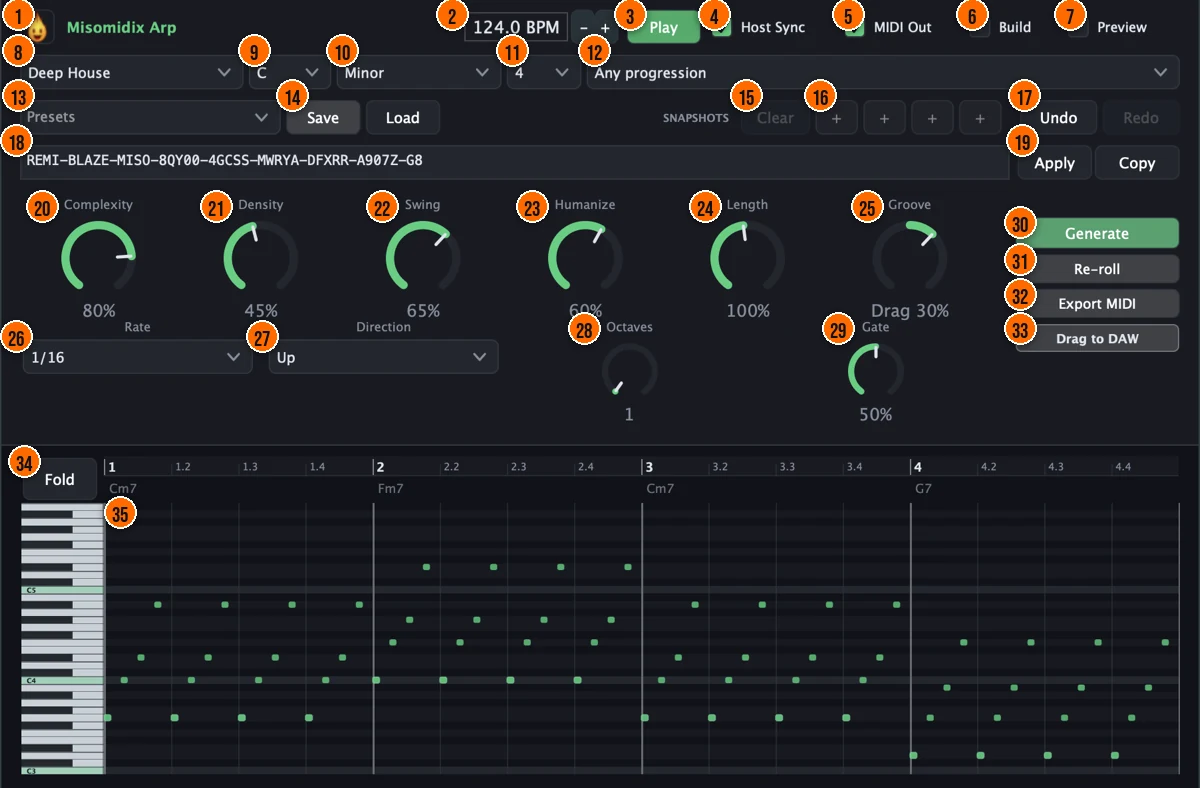
Controls
Top bar

- 1Fire Head: click the flame logo to open the About panel: what the plugin is, who made it, its version and the trademark notices. Click anywhere in the panel to close it.
- 2BPM: the tempo used when no host provides one, as in the Standalone app. In a DAW, the host's tempo is followed automatically.60 to 200 BPM, default 124
- 3Play: the plugin's own transport, used whenever the host isn't driving playback. It is on by default.
- 4Host Sync: follows your DAW's tempo and transport. Switch it off to audition with the plugin's own clock while the DAW is stopped.
- 5MIDI Out: the output gate: when it's on, the generated notes leave the plugin. If it's off, MisomidixArp still runs but nothing reaches your instrument. It is on by default.
- 6Build: regenerates the pattern as an energy build toward the drop: the part becomes a filter riser. It works best on 8 or 16 bars.
- 7Preview: plays the pattern through a built-in preview synth, so you can audition it in place. Route the MIDI to your own instrument for the final sound.
What to write

- 8Genre: the style the arp is written in. Each genre carries its own progression pool and voicing.Tech House, Deep Tech, House, Deep House, Melodic House, Progressive House, Afro House, Organic House, Bass House, Techno, Minimal, Drum & Bass, Hip Hop / Rap, RockTip Each genre carries its own progression pool and voicing. The arp sequences the chord's tones, so switching genres changes the notes the arp plays.
- 9Key: the key of the pattern. Key, scale and progression decide the notes; nothing is held down by hand.
- 10Scale: the scale the notes come from.
- 11Loop length: how many bars the loop is.
- 12Progression: picks a specific chord progression from the genre's pool. Any progression lets the genre choose by weight. The progression is generated first, then the arp sequences each chord's tones.Tip Pick a specific progression from the genre's pool to control the harmonic movement underneath the arp.
Presets, snapshots and codes

- 13Presets: presets store the generative formula, the settings that produce a kind of result, and are saved to disk by name.
- 14Save / Load: Save stores the current settings as a user preset; Load opens a preset file from anywhere on disk.
- 15Clear: empties all four snapshot slots. The pattern you're on is untouched.
- 16Snapshots: four numbered slots for this session. Click + to keep the pattern you're on (it becomes the next number), and click a number to come back to it. Alt-click a slot to store over it. Snapshots are saved with your project.
- 17Undo / Redo: undo and redo cover generating, re-rolls, preset loads, snapshot recalls and imports.
- 18Pattern code: the current pattern as a shareable code. Paste a code in and press Apply or Enter to get that exact pattern back.
- 19Apply / Copy: Apply loads the code in the box; Copy puts this pattern's code on your clipboard. Codes carry a checksum, so a mistyped code is refused instead of loading something else.
Macros

- 20Complexity: how complex the generated part is.0 to 100%
- 21Density: how many notes there are. Low for a sparse intro, high for a busy drop.0 to 100%Tip Density controls how many notes land per beat. Lower it for a sparse, hypnotic arp; raise it for a busy, driving pattern.
- 22Swing: the swing of the timing.0 to 100%Tip Swing pushes the off-beat arp notes later. Even a small amount of swing adds a groove to what would otherwise be a rigid sequence.
- 23Humanize: adds a human feel to the timing and playing.0 to 100%
- 24Length: note length: below 100% shortens notes toward staccato, above it lengthens them toward legato. Notes still never collide.10% to 200%
- 25Groove: leans the whole timing ahead of the beat (Rush) or behind it (Drag).Rush 100% to Drag 100%, with Straight in the middle
Arp

- 26Rate: how fast the arp runs.1/8 down to 1/32, including 8th and 16th tripletsTip Rate sets how fast the arp runs: from 1/8 notes down to 1/32, including 8th and 16th triplets.
- 27Direction: the order the chord's tones are played in.Up, down, up/down, random and convergeTip Direction controls the order: up, down, up/down, random and converge. Random breaks the predictable staircase pattern.
- 28Octaves: how many octaves the pattern spans.1 to 4Tip More octaves give the arp a wider sweep. One octave keeps it tight and focused on the chord's voicing.
- 29Gate: takes the arp from plucky and detached to running legato.Tip Gate runs from plucky and detached to legato. Short gates make each note a distinct tick; long gates let the notes overlap.
Generate and export
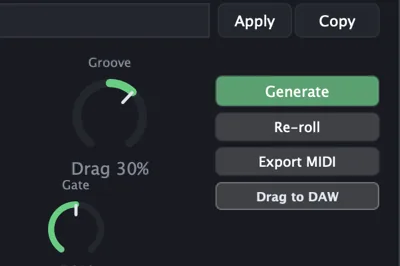
- 30Generate: generates a new pattern.
- 31Re-roll: re-rolls the arp.
- 32Export MIDI: saves the arp as a MIDI file.
- 33Drag to DAW: drag from this handle onto your timeline to take the pattern on screen into your session.
Piano roll
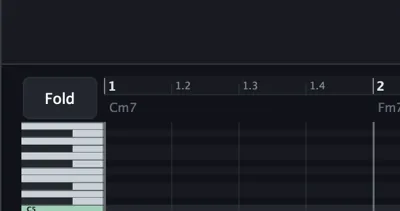
- 34Fold: shows only the pitches the part actually uses, so the piano roll stays compact.
- 35Piano roll: shows the notes of the arp. You can also drag it onto your timeline.
Meters and displays
- 35Piano roll: shows the notes, with the bar numbers along the top and the chord names above each bar, so you can see which chord the arp is playing.
- MIDI files on the window: drop a .mid file on the window to import it and re-shape your own material.
Key specs*
| Output | MIDI only; makes no sound on its own (a built-in preview synth is for auditioning) |
|---|---|
| Part | One: the arp |
| Genres | 14 |
| Macros | Complexity, Density, Swing, Humanize, Length, Groove |
| Rate | 1/8 to 1/32, including 8th and 16th triplets |
| Directions | 5: up, down, up/down, random, converge |
| Octaves | 1 to 4 |
| Tempo | Follows the host; 60 to 200 BPM when standalone |
| Recall | 4 snapshot slots (saved with the project), presets, checksummed pattern codes; seed-deterministic |
| MIDI out | Drag to the timeline, or export as a MIDI file |
| MIDI in | Drop a .mid file to re-shape your own material |
* Key specs from the plugin page. Some specs may not be listed.
How does the sound flow through MisomidixArp?
MisomidixArp writes MIDI, not audio. The harmony comes first, and the arp is written from it.
Arp directions
Direction sets the order the chord's tones are played in. The same three-note chord (C, E, G) produces a different pattern in each direction.
Up walks low to high; Down walks high to low; Up/Down bounces without repeating the turning notes; Random picks a tone each step; Converge works outside in, alternating the lowest and highest remaining tone.
How do I build an arp with MisomidixArp?
- Load it. Put MisomidixArp on a MIDI track ahead of an instrument, or open the Standalone app.
- Set the harmony. Pick a genre, a key, a scale and a loop length. Leave the progression on Any progression, or pick one from the genre's pool.
- Shape the arp. Choose a Rate and a Direction, and set Octaves for how wide the pattern runs.
- Set the feel. Use Gate to go from plucky and detached to legato. Swing, Humanize and Groove place the notes against the beat.
- Generate. Press Generate, or Re-roll for a new version. Keep the ones you like in the snapshot slots with +.
- Take it out. Drag the pattern onto your timeline with Drag to DAW, or press Export MIDI for a MIDI file. Copy the pattern code to get the result back later.
How do I create a driving arp riff with MisomidixArp?
- Pick a genre and key. Choose a genre like Tech House or Techno for a driving feel. Set the key and scale.
- Set the rate. Choose 1/16 for a fast, constant motion. 1/16 triplet adds a shuffle without using Swing.
- Set direction and octaves. Try Up with 2 octaves for a rising sweep, or Up/Down for a bouncing pattern.
- Shorten the gate. Pull Gate down for detached, plucky notes that cut through the mix.
- Drag it out. Drag the arp onto a MIDI track routed to a synth with a short attack and a filter. The arp carries the tempo from the host.
What about the full Misomidix?
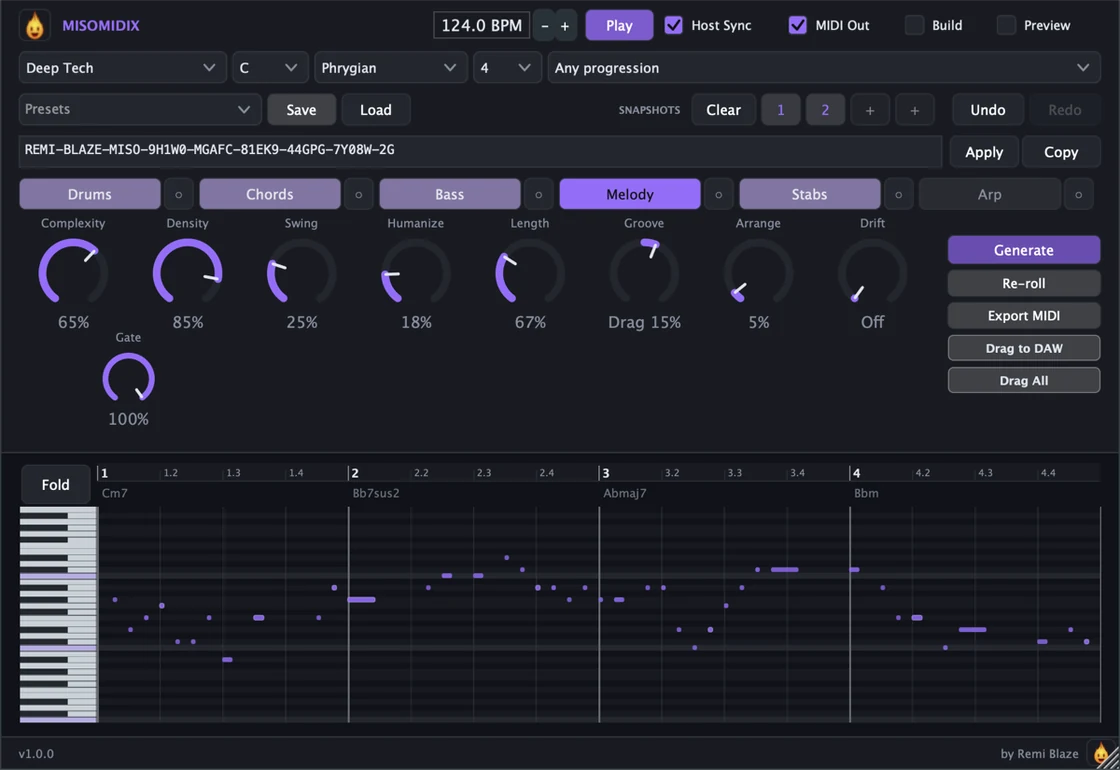
MisomidixArp writes the arp alone. Misomidix writes all six parts together on the same engine: drums, chords, bass, melody, stabs and arp, in an order where each part follows the ones before it. Lock the parts you like and re-roll the rest. Misomidix is also in the MIDI Bundle with Misomidix Raw, Ghostix and Vortix.
Keyboard and mouse shortcuts
These work in every MisomidixArp format (AU, VST3, CLAP, AAX, Standalone).
| Reset a control to its default | Double-click the knob or slider |
|---|---|
| Scroll to change a value | Hover over a knob and scroll the mouse wheel |
| Type an exact value | Click the value below a knob and type a number |
Frequently Asked Questions
Does the arp change when the chord changes?
Yes. The progression is generated first, then the arp sequences that chord's tones, so the pattern moves when the harmony moves.
What is the difference between Gate and Length?
Gate is the arp's own control, from plucky and detached to running legato. Length is one of the six macros: it sets note length from staccato (below 100%) to legato (above it).
How do I get a pattern back later?
Keep it in one of the four snapshot slots, save the settings as a preset, or copy its pattern code. Pasting the code back in with Apply gives you that exact pattern.
Why does MisomidixArp appear under Audio FX in my DAW?
In some hosts the CLAP version shows up under Audio FX as well as Instruments. Either one works.
I can't hear anything. What should I check?
MisomidixArp only writes MIDI, so route it to an instrument, or switch on Preview to audition it. Then check that Play and MIDI Out are on; both are on by default.
Where can I find more about MisomidixArp?
On the MisomidixArp page: its features, system requirements and how to get it.
How do I buy and install MisomidixArp?
- Buy it. MisomidixArp is a one-time purchase. Buy it from the MisomidixArp page, and the store emails you the download link.
- Run the installer. On macOS, double-click the .pkg file and choose AU, VST3, CLAP, AAX or Standalone. On Windows, run the .exe installer and choose VST3, CLAP or Standalone.
- Open your DAW. Restart your DAW and rescan plugins if needed, then find MisomidixArp under Remi Blaze in your plugin list.
More about MisomidixArp, including its features and system requirements, is on the MisomidixArp page.
Where are the plugin files?
If you need to find MisomidixArp on disk, for example to troubleshoot or to uninstall it manually, these are the standard locations.
| macOS AU | ~/Library/Audio/Plug-Ins/Components/ |
|---|---|
| macOS VST3 | ~/Library/Audio/Plug-Ins/VST3/ |
| macOS CLAP | ~/Library/Audio/Plug-Ins/CLAP/ |
| macOS AAX | /Library/Application Support/Avid/Audio/Plug-Ins/ |
| Windows VST3 | C:\Program Files\Common Files\VST3\ |
| Windows CLAP | C:\Program Files\Common Files\CLAP\ |
To uninstall, quit your DAW and delete the MisomidixArp file from the relevant folder. Your DAW will stop listing it on its next rescan.
Need help with MisomidixArp?
If something isn't covered here, or MisomidixArp doesn't behave as described, contact support or email support@remiblaze.com. To get an answer faster, include:
- your operating system and version (for example macOS 15.6 or Windows 11)
- your DAW and its version
- the format you're using (AU, VST3, CLAP, AAX or Standalone)
- the MisomidixArp version, shown in the About panel (click the Fire Head)
- what you did, what you expected, and what happened instead
This manual is for MisomidixArp 1.0.0. Controls and settings can change between versions, so if something here doesn't match what you see, check which version you have: click the Fire Head to open MisomidixArp's About panel. Spotted a mistake or have a question? Let us know.